A Moroccan wedding in Marrakech can bring together family, craftsmanship, music, fashion, ceremony and hospitality in a way that feels both deeply traditional and highly personal.
Yet there is no single formula that every Moroccan wedding must follow.
Some couples choose a celebration strongly rooted in traditional ceremonies. Others preserve selected customs while introducing contemporary styling, international wedding formats or a more intimate programme.
For destination couples, understanding the traditions before deciding which ones to include can make the experience much more meaningful.
Our complete guide to a Moroccan wedding in Marrakech explores the wider planning process. Here, we focus specifically on the traditions and ceremonial elements that can shape the celebration.
Moroccan Wedding Traditions Are Not One Fixed Formula
Morocco has a rich cultural identity influenced by different cities, regions, families and traditions.
For this reason, Moroccan weddings can vary considerably.
A wedding in Marrakech may not follow exactly the same customs, styling or programme as a celebration elsewhere in Morocco.
Family background can also influence:
- Garments
- Jewellery
- Music
- Food
- Bridal rituals
- Ceremonial entrances
- Timing
- The number of wedding days
- The level of formality
Modern couples increasingly create celebrations that combine family traditions with their own preferences.
The important point is not necessarily to include every possible custom.
It is to understand the meaning of the traditions you choose and integrate them naturally into the wedding.
The Henna Celebration
Henna is one of the traditions most strongly associated with Moroccan weddings.
Depending on the family and wedding format, the henna ceremony may take place before the main wedding celebration or form part of a wider series of pre-wedding events.
The atmosphere can be more intimate than the wedding itself, often bringing the bride together with family and close friends.
Traditional clothing, jewellery, music and decorative details can help create a distinctive identity for the occasion.
For destination weddings in Marrakech, the henna celebration can also provide international guests with an introduction to Moroccan culture before the main event.
Rather than treating it simply as another party, couples can work with their wedding and styling teams to create a celebration that respects the tradition while fitting naturally into the wider wedding experience.
The Negafa and Bridal Preparation
One of the most distinctive elements of Moroccan bridal tradition is the role of the Negafa.
For international couples unfamiliar with the term, a Negafa can be understood as a specialist in Moroccan bridal styling and ceremonial presentation.
Her role may include garments, jewellery, accessories, bridal changes and preparation for important moments throughout the celebration.
Our guide to the role of a Negafa in Moroccan bridal styling explains this tradition in greater detail.
The Negafa’s work is particularly visible when a bride wears several different Moroccan looks during the wedding.
However, the role is not simply about providing dresses.
The complete presentation of the bride is what creates the final result.
Caftans and Takchitas
Moroccan bridal fashion is one of the most recognisable elements of the celebration.
Caftans and takchitas can feature rich fabrics, embroidery, decorative buttons, structured belts and detailed craftsmanship.
A bride may choose several looks during the evening, each introducing a different colour, style or visual character.
For some couples, this progression becomes one of the central features of the wedding.
For others, fewer carefully selected looks create a more relaxed experience.
Our guide to Moroccan bridal styling in Marrakech explores how garments, jewellery and bridal transformations can be organised as one complete visual story.
Moroccan Bridal Jewellery
Jewellery is closely connected to the presentation of traditional Moroccan bridal looks.
Necklaces, earrings, belts, headpieces and other accessories can dramatically change the appearance of a caftan or takchita.
Certain looks may be highly ceremonial, while others may use jewellery more subtly.
The key is coordination.
Jewellery should work with the garment, hairstyle and bride rather than simply being added because it is traditional.
Couples interested in this aspect can explore our guide to Moroccan bridal jewellery in Marrakech for a closer look at how these elements are styled.
The Amaria and Ceremonial Entrances
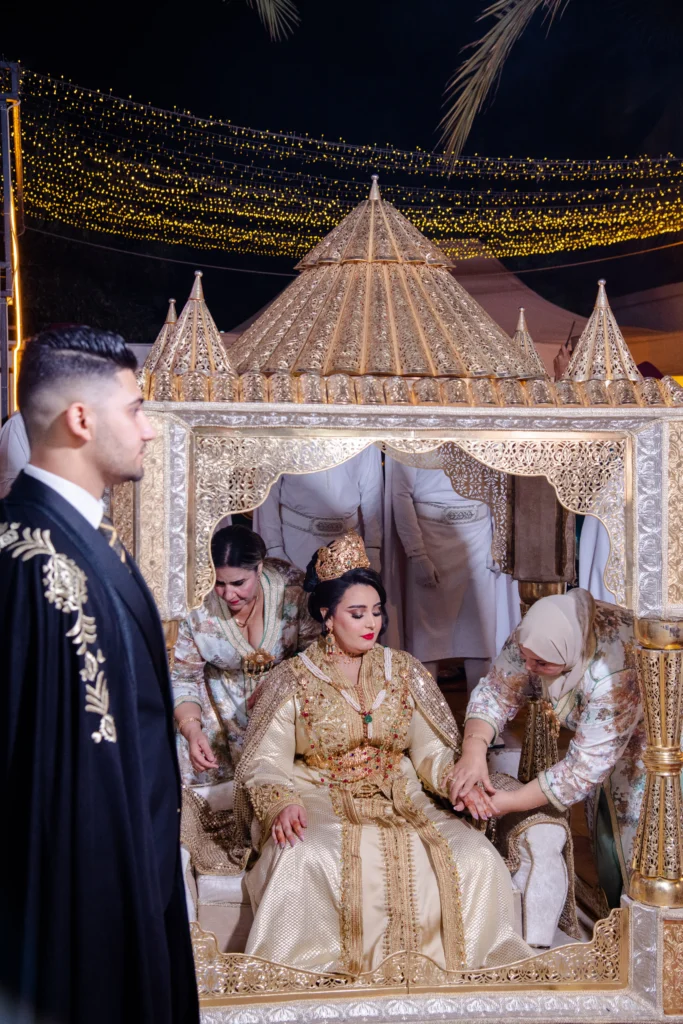
One of the most recognisable Moroccan wedding traditions is the ceremonial entrance of the bride — and sometimes the couple — elevated above the guests.
The Amaria creates a dramatic visual moment within the celebration.
Music, movement, clothing, timing and guest interaction all contribute to the atmosphere.
For destination couples, this may be one of the traditions they recognise immediately from Moroccan wedding imagery.
However, the moment works best when it is considered as part of the wedding programme rather than inserted without context.
The styling team, wedding planner, musicians, photographer and videographer may all need to understand when the entrance will happen.
Good coordination allows the couple to enjoy the moment while ensuring it is captured beautifully.
Music and Celebration
Music is fundamental to the energy of many Moroccan weddings.
The musical direction can change throughout the celebration, from ceremonial moments to dancing and entertainment later in the evening.
Traditional Moroccan music may be combined with contemporary music depending on the couple and their guests.
International destination weddings may move between Moroccan and global influences throughout the night.
The result does not need to feel divided between “traditional” and “modern.”
With thoughtful planning, both can coexist naturally.
The Bride’s Different Entrances
A Moroccan bride may appear several times throughout the wedding in different garments and jewellery.
Each entrance can introduce a new visual chapter.
But bridal changes should be considered carefully.
A wedding should not become a sequence in which the bride is constantly disappearing to change.
The number of looks needs to make sense for the schedule.
This is one reason couples often benefit from working with an experienced bridal stylist or Negafa in Marrakech who can advise on the progression of the bridal presentation.
The objective is to preserve the beauty of the tradition without compromising the bride’s experience of her own wedding.
Groom Styling and Moroccan Tradition
Although Moroccan bridal presentation often receives the greatest attention, the groom can also incorporate traditional Moroccan styling.
His garments can complement the bride without copying her appearance.
Colour, fabric, embroidery and level of formality can be considered together.
This creates stronger visual harmony during portraits, ceremonial entrances and moments where the couple appears together.
For mixed-cultural or international weddings, the groom may also alternate between Moroccan and Western formalwear during different parts of the celebration.
Food and Moroccan Hospitality
Hospitality is another defining part of Moroccan celebration.
Food, tea, sweets and the way guests are welcomed all contribute to the wedding experience.
The exact menu and service style vary according to the wedding, venue and family traditions.
Destination couples may choose a strongly Moroccan menu or combine Moroccan dishes with international influences.
As with the other elements of the wedding, authenticity does not necessarily require following one rigid format.
The experience should reflect both Moroccan hospitality and the identity of the couple.
Modern Moroccan Weddings
Traditional does not have to mean unchanged.
Many contemporary Moroccan weddings combine heritage with modern design, international event production and more editorial styling.
A bride may wear traditional Moroccan garments while the overall wedding décor feels contemporary.
A ceremony may incorporate a traditional entrance followed by an international dinner format.
A destination couple may include selected Moroccan traditions alongside customs from another culture.
The strongest weddings often feel cohesive because the traditions have been chosen intentionally.
They are not simply added as decorative features.
Moroccan Traditions for Destination Weddings in Marrakech
Marrakech is particularly suited to destination celebrations because Moroccan cultural elements can become part of the entire guest experience.
The architecture, food, music, fashion and hospitality of the city already create a strong sense of place.
For destination couples, the challenge is deciding how much tradition to include.
A useful approach is to identify the elements that genuinely speak to you.
That may include:
- A henna celebration
- Moroccan bridal styling
- One or more caftan looks
- Traditional jewellery
- An Amaria entrance
- Moroccan music
- Groom styling
- Traditional food
- Moroccan decorative details
A destination wedding does not need to include every tradition to feel connected to Morocco.
A few carefully planned elements can create a much stronger experience than trying to include everything.
Wedding Planners and Moroccan Traditions
For international wedding planners organising celebrations in Marrakech, understanding the ceremonial role of local specialists is important.
The planner may control the overall event schedule, venue and suppliers, while the Negafa or Moroccan bridal stylist works closely with the bride and ceremonial presentation.
These roles complement each other.
Communication between teams becomes especially important when bridal changes, ceremonial entrances or traditional music need to happen at precise moments.
This allows the wedding to maintain its overall production schedule without losing the cultural character of the traditions being included.
Choosing Which Traditions Belong in Your Wedding
There is no requirement for every Moroccan wedding to look the same.
A couple should choose traditions because they have meaning, because they connect to family heritage or because they genuinely want to experience them.
A modern Moroccan bride may select only two bridal looks rather than several.
An international couple may choose a henna celebration and ceremonial entrance while keeping the remainder of the wedding contemporary.
Another family may prefer a celebration with a much stronger traditional structure.
All of these approaches can be valid.
What matters is that the wedding feels coherent and personal.
Creating a Moroccan Wedding That Feels Like Yours
Moroccan wedding traditions offer couples a remarkable range of visual and ceremonial possibilities.
Caftans, jewellery, henna, music and entrances can all contribute to the celebration.
But the couple should remain at the centre.
The traditions should support the wedding rather than overwhelm it.
At Arouss Marrakech, Moroccan heritage is approached as something living — respected, understood and then interpreted around each celebration.
Explore our Experiences to discover Moroccan weddings, Negafa expertise, bridal styling and ceremonial services.
View the Arouss Marrakech Gallery for selected wedding moments and traditional bridal presentations.