The henna ceremony is one of the most recognisable pre-wedding traditions associated with Moroccan celebrations.
For many brides, it creates a more intimate moment before the main wedding — a time connected to family, tradition, beauty and preparation for the celebration ahead.
Yet a Moroccan henna ceremony does not need to follow one rigid format.
Its scale, styling and atmosphere can vary according to the bride, family traditions and the overall wedding concept.
For couples planning a Moroccan wedding in Marrakech, the henna event can become an important part of the wider experience, especially when guests have travelled from abroad and are discovering Moroccan wedding culture for the first time.
What Is a Moroccan Henna Ceremony?
The henna ceremony traditionally takes place before the main wedding celebration.
Depending on the family and wedding programme, it may be a relatively intimate gathering or a more elaborate event involving music, traditional clothing, décor, food and invited guests.
Henna itself has a long cultural presence across Morocco and other parts of North Africa and the Middle East.
Within the wedding context, it is closely associated with the bride and the transition into married life.
The exact rituals can differ between families and regions, so couples should not assume that every Moroccan henna celebration looks exactly the same.
That flexibility also allows modern brides to preserve the tradition while adapting the event to their own style.
When Does the Henna Ceremony Take Place?
The timing depends on the wedding format.
Some families organise the henna celebration shortly before the wedding day.
Others include it as part of a multi-day wedding programme.
For a destination wedding in Marrakech, this can work especially well because guests may already be staying in the city for several days.
Instead of beginning the experience directly with the principal wedding, the henna evening can become an opening celebration.
It gives guests time to gather, experience Moroccan hospitality and become familiar with some of the cultural elements that may also appear during the wedding.
Couples planning several events can read our guide to a destination wedding in Marrakech for more ideas on structuring the wider celebration.
What Does the Bride Wear for the Henna Ceremony?
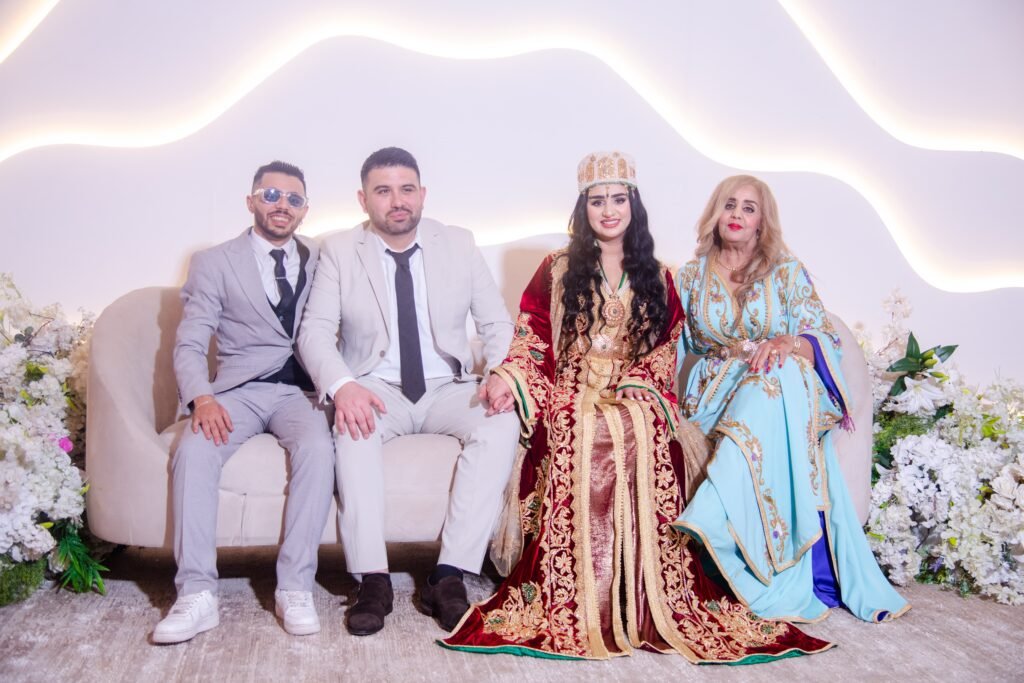
Traditional Moroccan clothing often plays an important role in the bride’s presentation.
The exact garment depends on the styling direction, family tradition and bride’s preferences.
Some brides choose a look strongly connected to traditional henna imagery.
Others create a more contemporary interpretation using a Moroccan caftan or takchita styled specifically for the evening.
The bride’s clothing should also be considered alongside jewellery, hairstyle, accessories and the atmosphere of the event.
This is where Moroccan bridal styling in Marrakech can help create a complete visual direction instead of treating the dress as an isolated choice.
Jewellery for the Henna Look
Jewellery can give the henna presentation a distinctive identity from the main wedding looks.
The bride may choose traditional accessories, a headpiece, statement earrings or a necklace depending on the garment.
However, the same principle applies as with wedding-day jewellery: every piece should contribute to the overall composition.
A highly detailed garment may require a more restrained approach.
A simpler look may allow stronger jewellery to become the focus.
Our guide to Moroccan bridal jewellery in Marrakech explores how necklaces, belts, earrings and headpieces can be balanced with different bridal garments.
The Role of the Negafa or Bridal Stylist
A henna celebration can also involve the expertise of a Negafa or Moroccan bridal stylist.
Depending on the services selected, the styling team may help with the bride’s garment, jewellery, accessories and presentation for the event.
For international brides unfamiliar with Moroccan wedding traditions, this guidance can make the planning process much easier.
Understanding the role of a Negafa in Moroccan bridal styling also helps explain why the styling of the bride is often approached as a complete experience.
The objective is not simply to provide a traditional outfit.
It is to create a presentation that suits the bride, the event and the cultural context.
Does a Henna Ceremony Need to Be Large?
No.
One of the advantages of the henna celebration is that it can be adapted to very different wedding formats.
Some brides prefer an intimate gathering with close family and friends.
Others create a larger evening with music, décor, food and a broader guest list.
For destination weddings, an intimate henna event can sometimes be particularly meaningful.
It gives the couple more time with close guests before the larger wedding celebration begins.
The scale should reflect the bride and the overall wedding programme rather than an expectation that every henna ceremony must look the same.
Creating the Atmosphere
The visual atmosphere of a henna ceremony can be very different from the main wedding.
Colour, lighting, textiles, flowers, candles and Moroccan decorative details can create a warmer and more intimate environment.
The styling does not necessarily need to reproduce the wedding décor.
In fact, creating a separate identity can help each event feel memorable.
For example, the henna evening may lean more strongly into Moroccan craftsmanship and traditional visual references, while the main wedding adopts a more contemporary direction.
The events remain connected without becoming repetitive.
Music and Celebration
Music can help shape the atmosphere of the henna evening.
Depending on the family and format, the celebration may incorporate traditional Moroccan music, contemporary music or a combination of both.
The event can begin in a more ceremonial tone and gradually become more relaxed.
For destination couples, this progression can provide international guests with a natural introduction to Moroccan celebration without requiring lengthy explanations.
They experience the tradition through the atmosphere of the evening itself.
Henna as Part of a Destination Wedding Weekend
A destination wedding in Marrakech often works best when guests experience more than one event.
The wedding weekend might include a welcome gathering, henna evening, principal wedding and a relaxed event afterward.
The exact programme depends on the couple.
A henna ceremony can be especially useful because it provides something culturally distinct from a conventional welcome dinner.
It immediately connects the wedding experience to Morocco.
At the same time, it can remain sophisticated, intimate and consistent with a luxury destination wedding.
Should International Brides Include a Henna Ceremony?
There is no requirement.
A couple should not include a tradition simply because they are getting married in Morocco.
The best approach is to understand the tradition first and decide whether it genuinely resonates with the bride and the wedding they are creating.
For some international brides, the henna event becomes one of their favourite parts of the celebration.
For others, different Moroccan traditions may feel more meaningful.
Our guide to Moroccan wedding traditions in Marrakech provides a broader overview of the customs couples may choose to incorporate.
The objective should always be thoughtful inclusion rather than creating a checklist of traditions.
Combining Moroccan and International Traditions
Many destination weddings bring together two cultures or family backgrounds.
The henna event can exist alongside traditions from another culture without creating conflict.
For example, a couple may hold a Moroccan henna celebration while incorporating ceremonies or customs from the groom’s family on another day.
The wedding then becomes an expression of both backgrounds.
This approach can work particularly well when each tradition is given enough space rather than trying to combine everything into a single moment.
Photography During the Henna Ceremony
The henna celebration can create some of the most detailed and intimate wedding imagery.
The bride’s hands, jewellery, fabrics, accessories and interactions with family can all become important photographs.
If the couple has hired a photographer for the destination wedding, it is worth discussing whether the henna event should also be documented.
The atmosphere may be very different from the main wedding and can add another chapter to the visual story of the celebration.
It is also useful for the photographer to understand which ceremonial moments are particularly important to the family.
Coordinating the Henna Event With Your Wedding Planner
For larger destination weddings, the wedding planner may coordinate the venue, décor, catering, entertainment and schedule of the henna evening.
The bridal stylist or Negafa can then focus more closely on the bride’s presentation and any traditional styling requirements.
These roles work best when the teams communicate.
If the bride needs preparation time, a particular entrance or a change of accessories, this should be reflected in the event schedule.
International planners working in Marrakech may also benefit from involving local specialists early when incorporating traditions they have not worked with before.
Keeping the Henna Experience Personal
Tradition should provide a foundation, not eliminate individuality.
The bride may want to honour family customs exactly as they have been practiced before.
Or she may want a lighter interpretation that still feels connected to Moroccan culture.
Both approaches can be meaningful.
The most important factor is that the event feels authentic to the people celebrating it.
The bride should feel comfortable in the clothing.
The atmosphere should match the couple.
And the traditions included should have a clear reason for being there.
From the Henna Ceremony to the Wedding Day
The henna event can also introduce the visual story that continues into the main wedding.
Colours, Moroccan craftsmanship or certain jewellery references may reappear later in a different form.
Alternatively, the henna celebration may deliberately look completely different.
Either approach can work.
The important part is considering the entire wedding experience rather than designing each event independently.
For couples still deciding how their bridal looks will develop throughout the celebration, our guide on how to choose a bridal stylist or Negafa in Marrakech can help clarify what to discuss with the styling team.
Creating a Henna Ceremony in Marrakech
A Moroccan henna ceremony can be intimate, elaborate, traditional, contemporary or somewhere between all of these.
What gives the experience meaning is not the number of decorative elements included.
It is the connection between the bride, her family, the tradition and the celebration she is preparing to enter.
At Arouss Marrakech, henna styling can form part of a wider approach to Moroccan bridal presentation, Negafa expertise and ceremonial direction.
Explore our Experiences to discover the Maison’s wedding and bridal services.
View the Arouss Marrakech Gallery for selected bridal styling and celebration moments.